
AIRPORT & AIRLINE CLEANING SERVICES · 24/7 SERVICE
AIRPORT CLEANING SERVICES FOR TERMINALS, HANGARS, AND AIRSIDE FACILITIES
Badge-ready janitorial crews for airports, FBOs, airline stations, and aircraft maintenance facilities.
Airport cleaning covers two environments with completely different rules. Landside is everything the public reaches without a badge: ticketing, baggage claim, pre-checkpoint concourses, restrooms, and parking. Airside is everything behind the security line — gate holdrooms, jet bridges, ramp-level spaces, hangars, and cargo buildings — where every worker needs a TSA-vetted badge or a continuous escort.
Mid City Cleaning Contractors has maintained commercial and industrial facilities for 60+ years. We build airport programs around the two things that govern the work: your security perimeter and your flight schedule.
AIRSIDE ACCESS
AIRSIDE ACCESS STARTS WITH BADGING, NOT WITH THE CLEANING CART
Any worker needing unescorted access to a Security Identification Display Area must hold a SIDA badge issued by the airport. That requires a TSA security threat assessment, a fingerprint-based criminal history check, and airport-specific training. TSA sets the standard; the airport issues the badge and sets its own processing window.
This is where airport contracts go wrong. A vendor who bids airside work without a credentialing plan either misses the start date or runs on escorted labor — which ties up one of your badged employees for every crew that walks in.
Access tiers are not interchangeable, and pricing without knowing which applies where is how scope disputes start:
TIER 01
LANDSIDE
No airport credential required.
TIER 02
AOA
Airport badge, plus airfield driver training for vehicle work.
TIER 03
SIDA / SECURED AREA
Badge displayed on the outermost garment at all times.
TIER 04
STERILE AREA
Post-checkpoint passenger zone, governed by the airport’s security program.
– We treat credentialing as the first line item of mobilization, not an afterthought discovered in week three.
AIRSIDE VS. LANDSIDE
AIRSIDE VS. LANDSIDE: WHAT ACTUALLY CHANGES
The difference is not the cleaning. It is credentialing, scheduling, and hazards.
| Landside | Airside | |
|---|---|---|
| Access | Open to the public | Badge or continuous escort |
| Vetting | Standard employment screening | TSA threat assessment, fingerprint check, training |
| Scheduled by | Passenger volume, terminal hours | Flight banks and aircraft movement |
| Hazards | Slips, crowding, biohazard | Loose debris, aircraft movement, fuel and hydraulic residue |
FACILITY TYPES
AVIATION FACILITIES WE CLEAN
An airport is a campus of buildings with almost nothing in common.Each needs a different program and a different standard.
01
MAIN TERMINALS AND TERMINAL HALLS
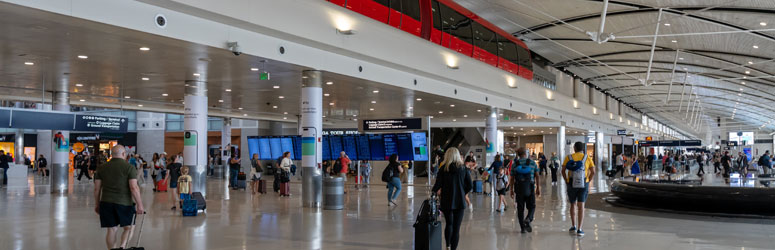
Continuous operation with no closure window. Day porter coverage during operating hours, restorative work overnight.
02
GATE AREAS AND HOLD ROOMS
Cleaned around passengers and aircraft turns, in the windows between flight banks rather than against them.
03
AIRCRAFT HANGARS AND MAINTENANCE FACILITIES
Oil, hydraulic fluid, and grinding dust, plus strict debris control, because a dropped fastener can end up in an engine intake.
04
FBOS AND CORPORATE FLIGHT DEPARTMENTS
Hotel standards judged by passengers who own the aircraft, on an unpredictable schedule.
05
AIR CARGO AND FREIGHT FACILITIES
Warehouse floor care, packaging waste, forklift traffic, and narrow overnight windows.
06
GROUND SUPPORT EQUIPMENT SHOPS
Industrial degreasing and parts-washing areas inside a security perimeter.
07
ADMINISTRATION AND SUPPORT BUILDINGS
Conventional interiors on a regulated campus. The easiest scope to add once a crew is badged, and the most commonly missed in a bid.
SCOPE OF WORK
WHAT AN AIRPORT CLEANING PROGRAM INCLUDES
Scope is written by area, not by task list, because the same surface carries a different standard depending on where it sits.
RESTROOMS – Cycle cleaning tied to passenger volume rather than a fixed clock, plus descaling, stocking, odor control, and scheduled terrazzo refinishing.
GATE AREAS – Disinfecting, trash removal, and vacuuming, timed around flight banks.
HIGH-TOUCH DISINFECTION – Gate counters, kiosks, handrails, seating, and charging stations, using EPA-registered products at labeled dwell time.


FLOOR CARE AND REFINISHING
Airport floors are the clearest evidence of whether a cleaning program is working, and the hardest surfaces to maintain without closing the area. Our floor work runs on a routine schedule rather than on complaint.
- Scheduled refinishing for high-traffic areas — strip, wax, and deep clean on a set interval, planned around operating hours instead of reacting to wear.
- Terrazzo and restroom floors — routine scheduled refinishing to hold appearance and protect the surface, rather than restoring it after damage.
- Hard floor maintenance — VCT strip and refinish, auto-scrubbing, polishing, and hangar concrete degreasing.
- Carpet cleaning without closing the floor — we run ride-on low-moisture extraction (Tennant R14) that leaves far less water in the carpet than conventional extraction, so concourses and gate areas return to foot traffic quickly instead of being roped off.
COMPLIANCE
COMPLIANCE, SAFETY,AND DOCUMENTATION
Airport contracts are audited contracts. What separatesvendors is whether the work can be proven.
We run quality assurance software that records inspections and generatesreporting, so you can see that each task was completed on its requiredschedule rather than taking our word for it. For a facility that has to answerto an airport authority, that record is the difference between asserting thework was done and showing it.
01: Personnel vetting on all staff, with TSA processing for badged areas
02: OSHA-aligned safety practices, including bloodborne pathogen response and hearing protection
03: EPA-registered chemistry applied to label, with safety data sheets on site
04: Green Seal and LEED-aligned products where a sustainability program requires them
05: Software-based quality control — inspections logged against a written standard, with reporting available to the facility
06: Consistent assigned crews, because badged personnel are a fixed asset and turnover is expensive
FROM SITE WALK TO FULL COVERAGE
HOW AN AIRPORT CONTRACT GETS STOOD UP
Mobilization runs on the badging clock. Everything else can be compressed; credentialing cannot.
STEP 01
SITE WALK AND SCOPE DEFINITION
Mapped by access tier, because that determines staffing and price. Square footage alone will not produce an accurate bid.
STEP 02
BADGING PACKAGE SUBMITTED
With fingerprinting scheduled immediately rather than after approval.
STEP 03 – AIRPORT CONTROLLED
VETTING IN PROCESS
Airports set their own windows; this step is outside any vendor’s control.
STEP 04
INTERIM ESCORTED COVERAGE
So the facility is never uncovered while landside scope runs at full staffing.
STEP 05
SECURITY TRAINING AND BADGE ISSUE
STEP 06
FULL UNESCORTED COVERAGE
With quality inspections on their contracted interval.